
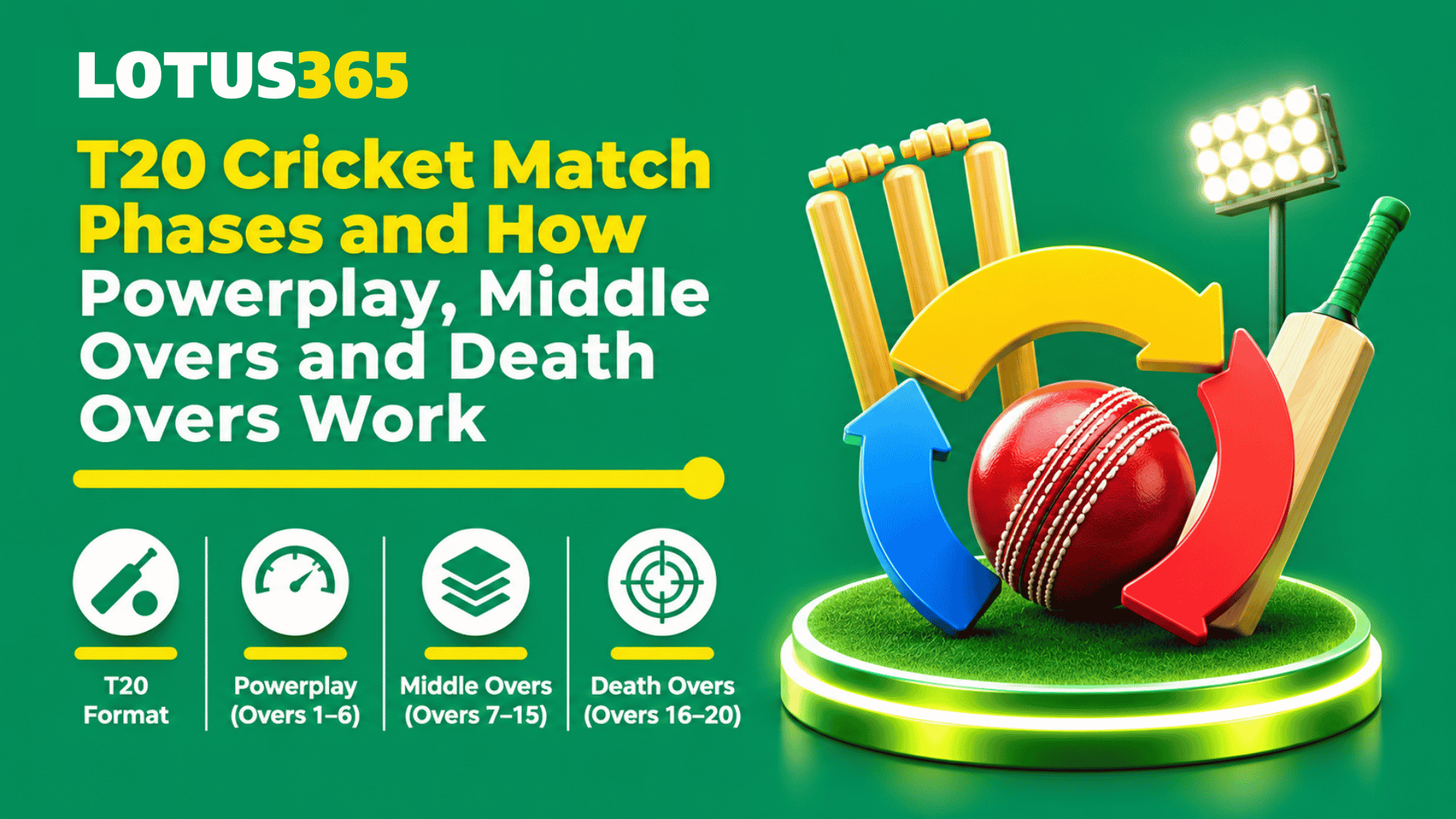
Twenty20 cricket is played at lightning pace, where one over can turn around the whole fortunes of a game. The knowledge of the T20 Cricket Match Phases can make fans, analysts, and players view the game as chess within big sixes and smart wickets. An average 20-over game is well divided into three parts: the power play, the tactics in the middle overs, and the death overs. All phases have their own fielding limitations, pitch styles, and tactical ambitions of both teams.
The T20 Cricket Match Phases at a Glance
The normal T20 game has 120 legal deliveries that are divided into 20 overs. Learning the T20 Cricket Match Phases reveals that captains change strategies according to the fielding regulations and wickets left.
- Phase 1 (Overs 16): The 30-yard circle only has two fielders, which makes the aggressive strokeplay of the hard new ball encouraged.
- Phase 2 (Overs 715): The focus can be changed to strike rotation and spin bowling, with up to five fielders who patrol the boundary.
- Phase 3 (Overs 16- 20): The teams push boundaries to the utmost on the boundaries where the set batters strike, and the bowlers deliver yorkers under extreme pressure.
To pursue a target, one needs to know their run rate required to follow over T20 Cricket Match Phases, and when batting first, one needs to set a par score.
| Match Phase | Over Range | Max Fielders Outside Circle | Primary Batting Goal | Primary Bowling Goal |
| Powerplay | Overs 1–6 | 2 Fielders | Maximise boundaries with minimal risk | Take early wickets with swing/seam |
| Middle Overs | Overs 7–15 | 5 Fielders | Rotate strike, target matchups, build base | Restrict boundaries, bowl dot balls |
| Death Overs | Overs 16–20 | 5 Fielders | Clear the ropes, hit 10–14+ runs per over | Execute yorkers, slower balls, wide lines |
Powerplay Explained: Rules and Fielding Restrictions
T20 powerplay rules regulate the first 6 overs of each innings, providing high-scoring opportunities to openers.
- There must be at least two on-station fielders in the ring at all times unless a team is receiving an over-rate penalty.
- The T20 powerplay rules give a reward to batters who either trigger infield by essential ground strokes or safely lift the ball to the margins of mid-off as well as mid-on.
- On the other hand, the new white ball is a genuine swing and moves the ball in the initial three overs.
- The international T20 statistics reveal that in circumstances where teams score 50+ runs without any wicket falling in the powerplay, there is a victory rate of more than 65%.
Supporters who see live game statistics and watch on websites such as the Lotus365 official website will tend to monitor how often powerplays have been completed to anticipate the number of innings.
T20 Batting Strategy During the Powerplay
An intelligent T20 batting strategy begins with openers evaluating the swing and bounce of the pitch in the first over.
- The T20 powerplay regulations allow the aerial work over extra cover and mid-wicket shots to be profitable since there are no deep cover boundary riders.
- When an opener is caught early, the No. 3 player takes orthodox quarter cricket shots to cement the innings without throwing away hits.
When calculating the T20 batting strategy, it is always important to apply it so that at the start of the seventh over, the team will have a good platform instead of being three down with 35.
Middle Overs in T20 Cricket
The middle overs in T20 cricket are between over 7 and over 15, which is 45% of the total number of overs.
- The middle overs in T20 cricket make a test of how a batter would turn dot balls into singles and twos by running hard.
- Set batters not only swing but also target each boundary per over and as many as four singles to sustain 8 runs per over.
- Maintaining at least six wickets by over 15 years old is crucial in mounting an attack during the last T20 Cricket Match Phases.
- Middle overs in T20 cricket can win or lose the match in silence; those who give 25 or more dots in the middle overs can hardly hit competitive totals.
Fans of cricket with live ball-by-ball feeds through the Lotus 365 download app can easily tell when a batting side has gone stagnant in these nine critical overs.
T20 Bowling Strategy in the Middle Overs
The T20 bowling strategy in overs 7-15 is based on the high importance of the wrist spinners, finger spinners, and medium-pace enforcers.
- The batters are forced to hit the longest boundaries by captains placing deep square leg, deep mid-wicket and long-on.
- Rapid bowlers open their hands on the ball and roll them to bowl off-cutters and leg-cutters, which take hold on worn surfaces.
- The strategy of T20 bowling is focused on the pressure of dot balls, as it is known that five dots in a row can virtually guarantee a bad shot.
A sensible T20 bowling strategy transforms a predicted 190 score to a winnable 155 after taking two or three wickets between overs 8 and 14.
Death Overs in Cricket
Death overs in the game of cricket are the last five overs (overs 16 to 20) when the entertainment and tension are on the highest gear.
- Each and every delivery in death overs in cricket has colossal effects, and the scoring rate has a tendency to soar over 11 runs per over.
- Batters slide their front leg to push the ball away across the cow corner or in a straight line down to the ground, or in cusps behind the wicket.
- Bowlers target the stumps, feet or broad outside off-stump and prevent batters from having any chance to swing.
Knowing T20 Cricket Match Phases, winning the final 30 balls is frequently more advantageous than a moderate beginning.
| Tactic Type | Batting Focus at the Death | Bowling Focus at the Death |
| Primary Shot / Delivery | Lofted straight drives, slog sweeps, ramps | Toe-crushing yorkers, wide yorkers, cutters |
| Field Exploitation | Hit into open pockets or over short boundaries | Bowl to the protected side of the ground |
| Risk Management | Turn miss-hits into twos; target weaker bowlers | Avoid full tosses, no-balls, and predictable lengths |
T20 Batting and Bowling Strategy at the Death
An effective T20 batting strategy in the last five overs combines a top-order batter who is settled with that of a dedicated power-hitter.
- The winning T20 batting strategy is about pre-meditating against the anticipated bowlers and responding quickly to the wide yorker shots.
- On the other hand, a steep T20 bowling plan is based on the use of 6 different kinds of deliveries in the over to ensure that the batter is not able to get into a rhythm.
- Bowling strategy of T20 over 1620 requires relaxed nerves, wide-line bowling and guarding the leg-side boundary.
Chasing teams ensure runs that will be required per over, and the data of T20 Cricket Match Phases are saved by the defending bowlers in order to have the best possible death bowler in overs 18 and 20.
T20 Match Analysis
Proper T20 match analysis considers not just the final scorecard but takes into consideration the performance at the three different stages.
- A 48/0 after six overs is much better than 55/3 due to the fact that wickets are the engine of acceleration in the future.
- The smart T20 match analysis is one associated with the speed of rotation of the strike between pairs in the middle overs of T20 cricket without taking unnecessary risks.
- As the evening progresses, dew tends to make the ball quite slick, nullifying the spinners and making the T20 bowling strategy more difficult in the second half.
- In contemporary teams, designated roles are given, such as a powerplay enforcer, a middle anchor, and finishers in the death overs in cricket.
- An overview of the phases of the T20 Cricket game shows that victory over two out of the three phases is almost a certainty to win almost 80 percent of T20 matches.
The T20 powerplay rules, efficiency, middle-over dot-ball percentage, and death-over boundary rates have been integrated to provide details about the actual tale of any game.
Conclusion
An analysis of T20 matches in these T20 Cricket Match Phases allows fans to enjoy each tactic on the field. Anytime online, get insights, live match statistics, and phase breakdowns on any cricket match at ilotus365.
FAQs
1. What are the three T20 Cricket Match Phases?
Three phases in T20 Cricket Matches, including the Powerplay (overs 1-6), the Middle Overs (overs 7-15) and the Death Overs (overs 16- 20).
2. How do T20 powerplay rules help the batting team?
According to the T20 powerplay, only two fielders will be used outside the 30-yard circle in the first six overs.
3. Why are middle overs in T20 cricket so important?
T20 Middle overs consist of nine overs with the fielders being five, guarding the boundary. Rotating teams are good at striking and restricting dot balls, creating a firm platform without forfeiting important dots.
4. What makes a good T20 bowling strategy during death overs in cricket?
An effective T20 cricket bowling plan on death overs entails a combination of right yorkers and wide remits coupled with a well-disguised slower ball. Different speeds will not allow finishers to swing freely through the ball line.
5. How does T20 match analysis use phase data to predict winners?
T20 match analysis compares the rate of runs, percentage of dot balls, and wickets lost in every stage to the average venue statistics. Winning teams that have won at least two of the three phases end up winning the match almost always.