
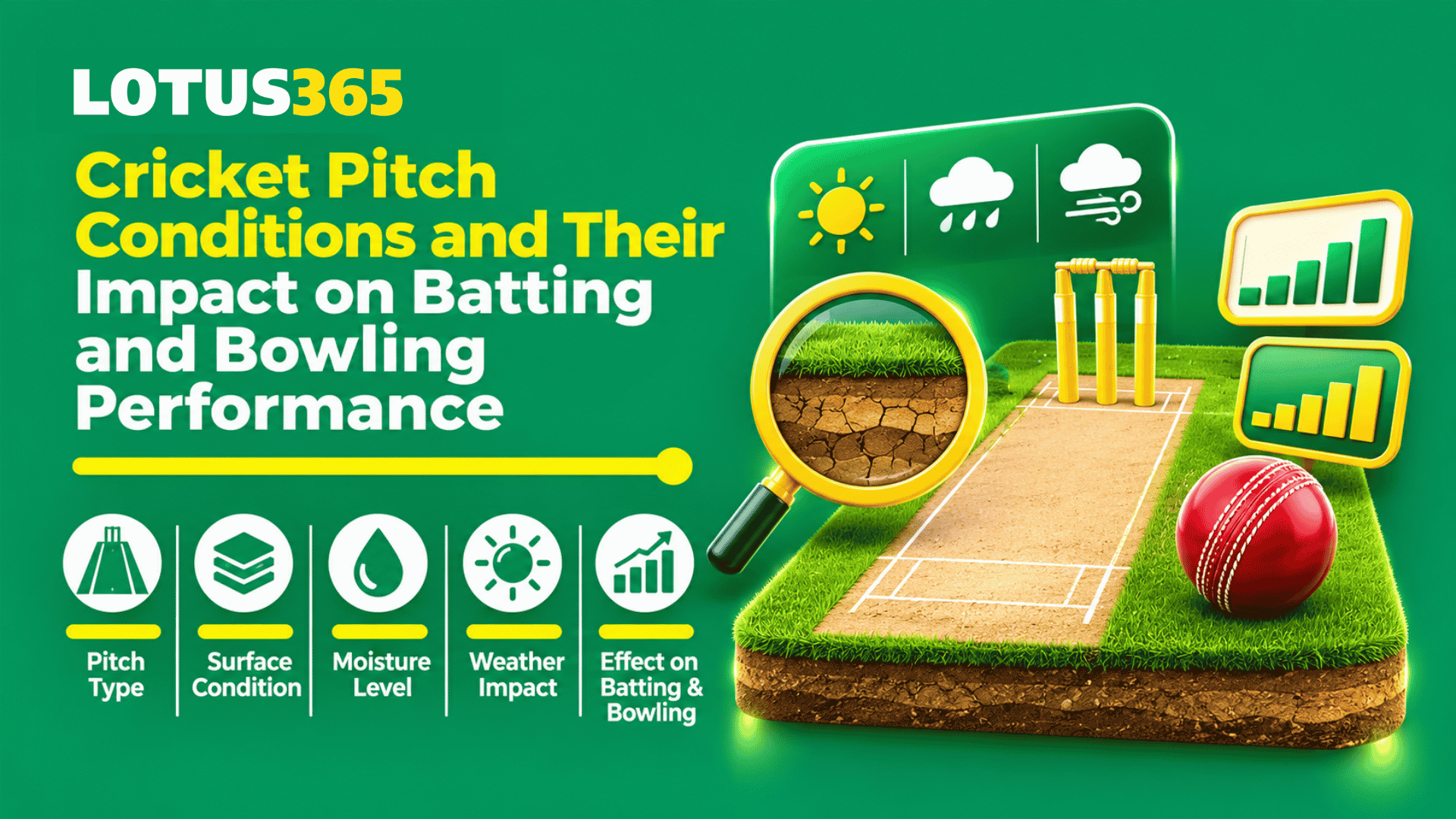
Some days one team scores 200, and the other side folds for 90. Why does this happen? Most times, the answer lies under the players’ feet. Cricket pitch conditions decide how the ball bounces, turns, and moves after it lands. That one thing changes how every batter plays and how every bowler plans.
Think of the pitch like a road. A smooth highway lets cars run fast. A bumpy village lane makes drivers slow down and think. Cricket works the same way.
In this guide, you will learn how a pitch is made, how to read a pitch report, and how each type of pitch changes the game in Tests, ODIs, and T20s. Every point is in easy words with real examples, so even a new fan can follow without any trouble. Now, let us begin at the very basics.
What Are Pitch Conditions In Cricket?
Pitch – a 22‑yard strip that sits in the center of the ground. This is where the bowler and the batter face each other. Cricket pitch conditions mean how this strip looks and plays on match day. Is it hard or soft? Is there grass? Are there cracks? Each answer changes how the ball behaves.
Things That Change a Pitch
| Factor | What It Means | Effect on Play |
| Grass | Green cover on the strip | Helps seam and swing |
| Moisture | Water in the soil | Ball may stay low or seam more |
| Hardness | How firm the top is | Gives bounce and carry |
| Soil | Black soil or red soil | Black is slower and lower, red gives more bounce |
| Cracks | Gaps that open as the strip dries | Helps spin and uneven bounce |
Types of Pitches in Cricket
Batting Friendly Pitch
A batting friendly pitch is hard, flat and dry, with very little grass. The ball comes onto the bat at the same height each time. So batters can trust their shots and play freely. Scores of 300 in ODIs and 180 in T20s are a regular thing here. Bowlers use slower balls and yorkers to stay in the game.
Look for a light brown, even surface with almost no grass. Short boundaries and a quick outfield also help runs flow.
Bowling Friendly Pitch
A bowling-friendly pitch has grass, wetness or cracks that give bowlers some help. Batters need to be careful here, and lower scores are normal. It comes in two main kinds.
Pace Friendly Pitch
A pace-friendly pitch is firm with a green tinge. The ball bounces higher and moves sideways off the seam. Perth in Australia is famous for this bounce. Cloudy mornings in England also suit fast bowlers.
Spin Friendly Pitch
A spin-friendly pitch is dry, dusty and often cracked. The ball grips the surface and turns sharply. Chepauk in Chennai is well known for helping spinners, mostly in the later part of a match.
How to Read a Cricket Pitch Report
Before the toss, a commentator walks on the pitch and tells viewers what to expect. He or she talks about grass, hardness, weather and a likely first-innings score. It is the fastest way to guess how a match may go.
Fans who like to follow live scores along with such match talk can visit the Lotus365 original site, which makes cricket updates easy to find in one place.
Pitch Report Words Made Simple
| Term | Simple Meaning |
| Good carry | Ball reaches the keeper at a nice height and speed |
| Two-paced | Ball comes slower off the pitch than expected |
| Variable bounce | Ball bounces at different heights |
| Dry and dusty | Likely to help spinners |
| Hard and bouncy | Likely to help fast bowlers |
Quick Checks Before the Toss
Here is a simple way to judge the pitch like a pro:
- Check the grass colour. More green means more help for fast bowlers.
- Look for cracks. More cracks mean spinners will enjoy the game.
- See recent scores at the same ground.
- Check the weather and whether it is a day or night game.
Doing these four things takes two minutes. It still gives a good idea of cricket pitch conditions before a ball is bowled.
How Cricket Pitch Conditions Affect Batting and Bowling
Effect on Batters
On flat pitches, batters attack early and build big partnerships. On green or turning pitches, things change. They wait for the ball, leave more deliveries and collect singles. Patience matters more than power here.
Effect on Bowlers
A smart bowler first studies the surface, then picks a plan. Fast bowlers pitch the ball up on seaming tracks. Spinners bowl tight and slow on dry ones. On flat tracks, change of pace and a good line do the job.
| Pitch Type | Batters Need | Bowlers Use | Usual Scores |
| Batting friendly | Big shots, timing | Slower balls, yorkers | High |
| Pace friendly | Strong defence | Swing, seam, bounce | Low to medium |
| Spin friendly | Quick feet, sweep shots | Turn and flight | Low, mostly later |
Pitch Conditions in T20 Cricket
A T20 game is only 20 overs per side, so the pitch gets used for a short time and usually plays true. Still, every ground has its own style. Wankhede in Mumbai often gives good bounce and high scores. Chepauk usually gives spinners more help. Knowing the ground helps in guessing the total.
Pitch conditions in T20 cricket at night
In evening games, dew makes the ball wet and slippery. Spinners then find it hard to grip, and chasing becomes easier. This is why many captains choose to bowl first under lights.
Fans who enjoy night matches and fresh match talk can also explore Lotus Cricket 365 for easy cricket updates.
How a Pitch Changes in a Test Match
A Test lasts five days, so cricket pitch conditions are never the same on day one and day five.
| Day | What Usually Happens |
| Day 1 | Some grass and moisture, so seamers get help |
| Day 2 and 3 | Surface settles, batting is easiest |
| Day 4 and 5 | Cracks open, spin and uneven bounce grow |
That is why batting last in the fourth innings is often the hardest job.
How Weather Changes the Pitch
Rain, sun, covers and humidity all play a part. A cloudy sky helps the ball swing in the air. Hot sun dries the strip and opens cracks faster. Covers protect the pitch from rain, though a damp surface can still keep the ball low. Always read the forecast along with the pitch report, because cricket pitch conditions can shift within hours.
Conclusion
A pitch tells the story of a match before it begins. Once you learn to spot grass, cracks, bounce and weather, many things start making sense. You will know why captains bowl first, why spinners come on early and why some grounds always see big scores. Cricket pitch conditions are the quiet hero behind many results. So next match day, listen to the pitch report, watch the first few overs and make your own guess. Keep learning, stay curious and enjoy the game responsibly. Share this guide with a friend who loves cricket!
FAQs
1. What’s a cricket pitch report?
It is a talk before the match that tells you how the pitch might play and what score to expect.
2. What’s the best pitch to swing at?
A hard surface that is flat and dry and doesn’t have grass is good, for batting.
3. Why do spinners like to bowl on dry pitches?
On a dry, cracked pitch the ball holds better and turns more sharply.
4. What is a green pitch?
Green pitch is covered with grass on its surface, and is helpful for fast bowlers and seam.
5. Does dew impact T20 matches?
Yes. Dew makes the ball wet and therefore helps chasers but is bad for spinners.
6. How long is a cricket pitch?
A cricket pitch is 22 yards, or about 20.12 metres, long.
7. Why does a Test pitch change over five days?
It dries, wears and cracks as players run and the ball lands on it again and again.